
Cabinet approves major expansion of postgraduate and undergraduate medical education capacity in the country
The Union Cabinet chaired by the Prime Minister, Shri Narendra Modi, has approved the Phase-Ill of the Centrally Sponsored Scheme (CSS) for strengthening and upgradation of existing State Government/ Central Government Medical Colleges/ Standalone PG Institutes/ Government Hospitals for increasing 5,000 PG seats and extension of the CSS for upgradation of existing government medical colleges for increasing 5,023 MBBS seats with an enhanced cost ceiling of Rs. 1.50 crore per seat. This initiative will significantly: augment the undergraduate medical capacity; availability of specialist doctors by creating additional postgraduate seats; and enable introduction of new specialties across Government medical institutions. This will strengthen the overall availability of doctors in the country.
The total financial implications of these two schemes is Rs.15,034.50 crore for a period from 2025-26 to 2028-29. Out of Rs.15034.50 crore, the central share is Rs.10,303.20 crore and the state share is Rs.4731.30 crore.
Benefits:
Schemes for augmenting medical seats in government medical colleges/institutions across State/UTs will help augment the availability of doctors and specialists in the country, thereby improving access to quality healthcare, especially in underserved areas. It will also leverage existing infrastructure for cost-effective expansion of tertiary healthcare in the Government institutions as expansion of postgraduate seats ensures a steady supply of specialists in critical disciplines. These schemes aim to promote balanced regional distribution of healthcare resources, while being cost-effective by leveraging existing infrastructure. In the long run, they strengthen the country’s health systems to meet existing and emerging health needs.
Impact, including employment generation:
The major output/outcome expected from the schemes are:
i. Providing more opportunities to the students to pursue medical education in India.
ii. Enhancing the quality of medical education and training to meet global standards.
iii. Adequate availability of doctors and specialists can position India as a prime destination for providing affordable healthcare and thus boosting foreign exchange.
iv. Bridging the gap in healthcare accessibility, particularly in underserved rural and remote areas.
v. Generating of direct and indirect employment opportunities in terms of doctors, faculty, paramedical staff, researchers, administrators and support services.
vi. Strengthening the health system’s resilience and contributing to overall socio- economic development.
vii. Promoting equitable distribution of healthcare infrastructure across States/UTs.
Implementation Strategy and targets:
The target of these schemes is to increase 5000 PG seats and 5023 UG seats in government institutions by 2028-2029. Detailed guidelines will be issued by the Ministry of Health & Family Welfare (MoH&FW) for implementation of the schemes.
Background:
Realizing Universal Health Coverage (UHC) for 1.4 billion people critically depends on building a robust healthcare system capable of delivering timely, high-standard services at all levels—particularly in rural, tribal, and hard-to-reach communities. A robust healthcare system hinges on availability of skilled and adequate workforce.
India’s healthcare education and workforce infrastructure has witnessed significant growth in recent years, reflecting a sustained policy focus on expanding access and improving quality. As on date, India has 808 medical colleges, highest amongst the world with total intake capacity of 1,23,700 MBBS seats. In the last one decade, added over 69,352 new MBBS seats registering a growth of 127%. Similarly, during this period 43,041 PG seats were added showing an impressive growth of 143%. In spite of this notable growth in number of medical seats, in certain regions there is a need to enhance capacities to match the demand, access and affordability of healthcare.
Further, the twenty-two new All India Institute of Medical Sciences (AIIMS) approved under the Pradhan Mantri Swasthya Suraksha Yojana (PMSSY) apart from providing tertiary healthcare services are also playing an important role in building a pool of health professionals with highest standards of medical competence with their state-of-the-art teaching learning facilities.
To expand the pool of qualified faculty, new Medical Institution (Qualifications of Faculty) Regulations 2025 have been issued by adopting a more inclusive and competency-based approach to faculty eligibility and recruitment. These changes aim to address the growing requirement of teaching personnel, and meeting the academic and professional standards.
To augment the availability of qualified human resource in health, MoH&FW is administering these schemes and their further extension underscores the Government’s commitment of creating capacity for production of more medical professionals, strengthening human resources for health, and improving access to quality healthcare services for the people of India.
Cabinet approves DSIR Scheme “Capacity Building and Human Resource Development” with an outlay of Rs.2277.397 crore
The Cabinet, chaired by the Prime Minister Shri Narendra Modi, has approved the Department of Scientific and Industrial Research / Council of Scientific and Industrial Research (DSIR/CSIR) Scheme on “Capacity Building and Human Resource Development” with a total outlay of Rs.2277.397 crore for the period of the Fifteenth Finance Commission Cycle 2021-22 to 2025-26.
The scheme is implemented by the CSIR and will cover all R&D institutions, national laboratories, Institutes of National Importance, Institutes of Eminence, and Universities across the country. The initiative provides a wide platform for young, enthusiastic researchers aspiring to build careers in universities, industry, national R&D laboratories, and academic institutions. Guided by eminent scientists and professors, the scheme will foster growth in Science, Technology & Engineering, Medical, and Mathematical Sciences (STEMM).
The Capacity Building and Human Resource Development Scheme plays an important role in the achievement of the Sustainable Development Goals (SDGs) for the S&T sector in India by increasing the researchers per million population. The Scheme has demonstrated its relevance by building capacity and expanding the pool of high-quality human resources in the S&T sector.
Concerted efforts put in Research and Development (R&D) in Science and Technology (S&T) by the Government of India during last decade, India has improved its position in the Global Innovation Index (GII) to 39th rank in 2024 as per the World Intellectual Property Organisation (WIPO) ranking which will further improve in near future under the visionary guidance of the Prime Minister of India. As a result of support to R&D by the Government, India is now among the top three in terms of scientific paper publications as per NSF, USA data. DSIR’s scheme is supporting thousands of research scholars and scientists whose outputs have contributed significantly to India’s S&T achievements.
This approval creates a historical milestone in CSIR on its 84 years of service to Indian scientific and industrial research, through the umbrella scheme implementation, which accelerates the country’s R&D progress in the present and future generations. CSIR umbrella scheme “Capacity Building and Human Resource Development (CBHRD) which has four sub-schemes such as (i) Doctoral and Postdoctoral Fellowships (ii) the Extramural Research Scheme, the Emeritus Scientist Scheme, and the Bhatnagar Fellowship programme; (iii) Promotion and Recognition of Excellence through the Award Scheme; and (iv) Promoting knowledge sharing through the Travel and Symposia Grant Scheme.
This initiative reflects the Government’s commitment towards building a robust R&D driven innovation ecosystem and preparing Indian science for global leadership in the 21st century.
Cabinet approves Productivity Linked Bonus for 78 days to railway employees
In recognition of the excellent performance by the railway staff, the Union Cabinet chaired by the Prime Minister Shri Narendra Modi today approved payment of Productivity Linked Bonus (PLB) of 78 days for Rs.1865.68 crore to 10,91,146 railway employees.
Payment of PLB to eligible railway employee is made each year before the Durga Puja / Dussehra holidays. This year also, PLB amount equivalent to 78 days’ wages is being paid to about 10.91 lakh non-gazetted railway employees. The payment of PLB acts as an incentive to motivate the railway employees for working towards improvement in the performance of the Railways.
The maximum payable amount of PLB equivalent to 78 days’ wages for each eligible railway employee is Rs.17,951/-. The above amount will be paid to various categories, of railway staff like Track maintainers, Loco Pilots, Train Managers (Guard), Station Masters, Supervisors, Technicians, Technician Helpers, Pointsman, Ministerial Staff and other Group ‘C’ staff.
The performance of Railways in the year 2024-25 was very good. Railways loaded a record cargo of 1614.90 Million Tonnes and carried nearly 7.3 billion passengers.
Comprehensive 4-Pillar Approach to Strengthen Shipbuilding, Maritime Financing, and Domestic Capacity
Cabinet approves Rs.69,725 crore Package to Revitalize India’s Shipbuilding and Maritime Sector
Shipbuilding Financial Assistance Scheme extended until 31st March 2036 with a total corpus of Rs.24,736 crore
Maritime Development Fund approved with Maritime Investment Fund of Rs.20,000 crore
Shipbuilding Development Scheme with an outlay of Rs.19,989 crore aims to expand domestic shipbuilding capacity to 4.5 million Gross Tonnage
Recognizing the strategic and economic importance of the maritime sector, the Union Cabinet, chaired by Prime Minister Shri Narendra Modi, today approved a comprehensive package of Rs.69,725 crore to revitalize India’s shipbuilding and maritime ecosystem. The package introduces a four-pillar approach designed to strengthen domestic capacity, improve long-term financing, promote greenfield and brownfield shipyard development, enhance technical capabilities and skilling, and implement legal, taxation, and policy reforms to create a robust maritime infrastructure.
Under this package, the Shipbuilding Financial Assistance Scheme (SBFAS) will be extended until 31 March 2036 with a total corpus of Rs.24,736 crore. The scheme aims to incentivize ship building in India and includes a Shipbreaking Credit Note with an allocation of Rs.4,001 crore. A National Shipbuilding Mission will also be established to oversee the implementation of all initiatives.
In addition, the Maritime Development Fund (MDF) has been approved with a corpus of Rs.25,000 crore to provide long-term financing for the sector. This includes a Maritime Investment Fund of Rs.20,000 crore with 49% participation from the Government of India and an Interest Incentivization Fund of Rs.5,000 crore to reduce the effective cost of debt and improve project bankability. Furthermore, the Shipbuilding Development Scheme (SbDS), with a budgetary outlay of Rs.19,989 crore, aims to expand domestic shipbuilding capacity to 4.5 million Gross Tonnage annually, support mega shipbuilding clusters, infrastructure expansion, establish the India Ship Technology Centre under the Indian Maritime University, and provide risk coverage, including insurance support for shipbuilding projects.
The overall package is expected to unlock 4.5 million Gross Tonnage of shipbuilding capacity, generate nearly 30 lakh jobs, and attract investments of approximately Rs.4.5 lakh crore into India’s maritime sector. Beyond its economic impact, the initiative will strengthen national, energy, and food security by bringing resilience to critical supply chains and maritime routes. It will also reinforce India’s geopolitical resilience and strategic self-reliance, advancing the vision of Aatmanirbhar Bharat and positioning India as a competitive force in global shipping and shipbuilding.
India has a long and illustrious maritime history, with centuries of trade and seafaring that connected the subcontinent to the world. Today, the maritime sector remains a backbone of the Indian economy, supporting nearly 95% of the nation’s trade by volume and 70% by value. At its core lies shipbuilding, often described as the “mother of heavy engineering,” which not only contributes significantly to employment and investment but also enhances national security, strategic independence, and the resilience of trade and energy supply chains.
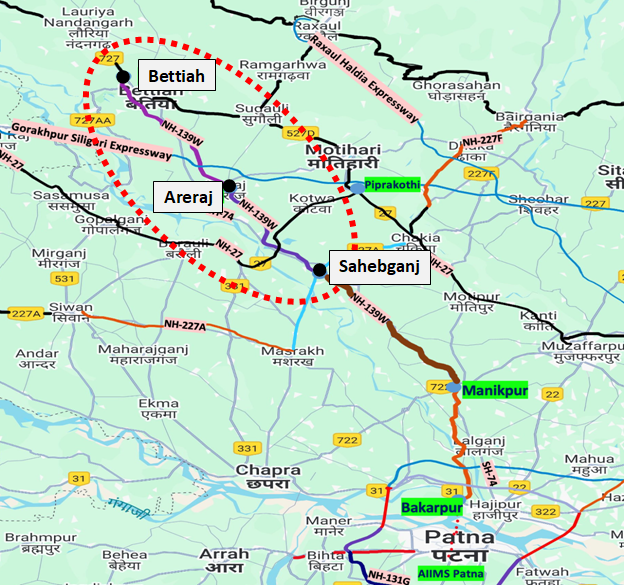
Cabinet approves Construction of 4-lane Sahebganj-Areraj-Bettiah section of the NH-139W in Bihar on Hybrid Annuity Mode (HAM) with a total project length of 78.942 km worth Rs.3,822.31 crore
The Cabinet Committee on Economic Affairs chaired by the Prime Minister Shri Narendra Modi today has approved the Construction of 4-lane Sahebganj-Areraj-Bettiah section of the NH-139W in Bihar on Hybrid Annuity Mode (HAM) with a total project length of 78.942 km and total capital cost of Rs.3,822.31 crore.
The proposed four-lane greenfield project is to improve connectivity between the State Capital Patna with Bettiah connecting the North Bihar Districts of Vaishali, Saran, Siwan, Gopalganj, Muzaffarpur, East Champaran and West Champaran up to the areas along the Indo-Nepal border. The project will support the movement of long-distance freight traffic, improve access to key infrastructure and facilitate regional economic development by improving connectivity to agricultural zones, industrial areas, and cross-border trade routes.
The project will connect seven PM Gati Shakti economic Nodes, six Social Nodes, eight Logistic Nodes, nine Major Tourism and Religious Centers by improving access to key heritage and Buddhist tourist sites including the Kesariya Buddha Stupa (Sahebganj), Someshwarnath Mandir (Areraj), Jain Mandir and Vishwa Shanti Stupa (Vaishali), and Mahavir Temple (Patna), thereby strengthening the Buddhist circuit and international tourism potential of Bihar.
The NH-139W has been planned to provide a high-speed connectivity to alternate routes that are presently congested and geometrically deficient, and pass-through built-up areas and will serve as an important link to the NH-31, NH-722, NH-727, NH-27 and NH-227A.
The proposed greenfield alignment will support average vehicular speeds of 80 km/h against the design speed of 100 km/h. This will reduce the overall travel time between Sahebganj and Bettiah, from 2.5 hours to 1 hours, compared to existing alternatives, while offering safe, fast and uninterrupted connectivity for both passenger and freight vehicles.
The proposed project with length of 78.94 km will generate close to 14.22 lakh man-days of direct employment and 17.69 lakh man-days of indirect employment. The project will also induce additional employment opportunities due to increase in economic activity in the vicinity of the proposed corridor.
Project Alignment Map for Sahebganj-Areraj-Bettiah section of NH-139W
Cabinet approves doubling of Bakhtiyarpur – Rajgir – Tilaiya single railway line section (104 Km) in Bihar with total cost of Rs. 2,192 crore
The Cabinet Committee on Economic Affairs, chaired by the Prime Minister Shri Narendra Modi, has approved the doubling of Bakhtiyarpur – Rajgir – Tilaiya single railway line section (104 km) in Bihar with total cost of Rs. 2,192 crore (approx.).
The project covering four Districts in the state of Bihar will increase the existing network of Indian Railways by about 104 Kms.
Project section also provides rail connectivity to prominent destinations such as Rajgir (Shanti Stupa), Nalanda, Pawapuri etc. attracting pilgrims and tourists from across the country.
Multi-tracking projects will enhance connectivity to approx. 1,434 villages and about 13.46 lakh population and two Aspirational Districts (Gaya and Nawada).
This is an essential route for transportation of commodities such as coal, cement, clinker, fly ash etc. The capacity augmentation works will result in additional freight traffic of magnitude 26 MTPA (Million Tonnes Per Annum). The Railways being environment friendly and energy efficient mode of transportation, will help both in achieving climate goals and minimizing logistics cost of the country, reduce oil import (5 Crore Litres) and lower CO2 emissions (24 Crore Kg) which is equivalent to plantation of 1 (One) Crore trees.
The enhanced line capacity will improve mobility, providing enhanced efficiency and service reliability for Indian Railways. The multi-tracking proposal will ease operations and reduce congestion, providing the much-required infrastructural development on the busiest sections across Indian Railways. The projects are in line with Prime Minister Shri Narendra Modi’s vision of a New India which will make people of the region “Atmanirbhar” by way of comprehensive development in the area which will enhance their employment/ self-employment opportunities.
The projects are planned on PM-Gati Shakti National Master Plan with focus on enhancing multi-modal connectivity & logistic efficiency through integrated planning and stakeholder consultations. These projects will provide seamless connectivity for movement of people, goods, and services.