Cabinet approves “Mission for Cotton Productivity” with Rs.5659.22 crore Outlay for Self-Sufficiency in Cotton and Competitiveness in Global Textile Markets by 2030-31
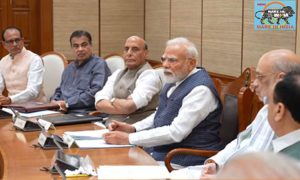
The Union Cabinet chaired by the Prime Minister Shri Narendra Modi has approved Rs.5659.22 crore for Mission for Cotton Productivity (2026–27 to 2030–31) to address bottlenecks, declining growth, and quality concerns in India’s cotton sector.
The mission aligns with the 5F vision (Farm to Fibre to Factory to Fashion to Foreign) of Government of India. The Mission focuses on enhancing cotton productivity through development of High yielding variety (HYV) seeds resistant to disease and pests, scaling up of existing and latest crop production technologies through states governments, Krishi Vigyan Kendras, and State Agricultural Universities (SAUs) through large-scale promotion and adoption of latest crop production technologies, ensures least contaminant cotton supply to industry, and promote high-quality cotton exports with focus on the following major aspects:
- Development of High-yielding, climate resilient, pest-resistant seeds, and other production/protection technologies
- Upscaling improved cotton production technologies like High Density Planting System (HDPS), Closer Spacing (CS), Integrated Cotton Management, and promotion of Extra Long Staple (ELS) Cotton
- Augmenting quality of cotton through capacity building and promoting modernization of ginning and processing factories, including adoption of best processing practices.
- Strengthening cotton testing infrastructure across the country with modern, standardized, and accredited facilities to ensure reliable quality assessment and global benchmarking.
- Robust branding and traceability initiatives under Kasturi Cotton Bharat to position Indian cotton as a premium, sustainable, and globally trusted product.
- Empowering farmers through digital integration of market yards (mandis), enabling transparent price discovery, direct market access, and improved realization through e-platforms
- Promotion of cotton waste recycling and circular economy practices to enhance resource efficiency, reduce environmental footprint, and generate additional value streams for the industry
- Diversification of India’s fibre base by including natural fibres like flax, ramie, sisal, milkweed, bamboo and banana and advancement of environmentally sustainable textile production and innovations. Its strategic integration and promotion to complement cotton and align India’s textile sector with evolving global demand patterns.
The Mission will be implemented by the Ministry of Agriculture and Farmers Welfare and Ministry of Textiles, involving 10 institutes of Indian Council of Agricultural Research (ICAR), one institute of Council for Scientific and Industrial Research (CSIR), and 10 centres of All India Coordinated Research Project (AICRPs) on Cotton operating in different State Agricultural Universities (SAUs) of major cotton growing states. Initially, 140 districts will be focussed in 14 States through State Department of Agriculture and ICAR for upscaling the technologies and 2000 ginning/ processing factories. Development of high-yielding climate resistant and pest-resistant seeds, deploy modern farming technologies, farmer training, quality improvement, traceability, and strengthening infrastructure by promoting sustainable fibres and innovation across the cotton value chain.
The Mission envisages to accomplish the production of 498 lakh bales (170 kg lint each) of cotton by enhancing lint productivity from 440 kg/ha to 755 kg/ha by 2031. Approximately 32 lakh farmers will be benefitted leading to self-reliance. Promotion of Kasturi Cotton Bharat for traceability and certification, targeting trash reduction <2% and promotion of natural fibres like flax, ramie, sisal, milkweed, bamboo and banana. This is a milestone in making the country self-reliant in Cotton Sector.
Cabinet approves Ship Repair Facility at Vadinar, Gujarat
The Cabinet Committee on Economic Affairs, chaired by the Prime Minister Shri Narendra Modi, today has approved the development of a state‑of‑the‑art Ship Repair Facility at Vadinar, Gujarat, marking a major expansion of the national ship repair ecosystem. The project will be jointly implemented by Deendayal Port Authority (DPA) and Cochin Shipyard Limited (CSL), with a combined investment of Rs.1,570 crore.
The project is planned as a brownfield facility with a 650 metres jetty, two large floating dry docks, workshops and associated marine infrastructure. Vadinar’s natural deep draft, connectivity to major shipping routes, and proximity to key ports such as Mundra and Kandla make it an optimal location for repair operations, particularly for large commercial and foreign‑flagged vessels.
The project will also create opportunities for skill development and generate direct and indirect employment, while enabling the growth of maritime ancillary services and MSMEs in the surrounding region.
Impact:
The Vadinar Ship Repair Facility will directly address a critical gap in India’s ship repair infrastructure, as the country currently lacks adequate domestic capacity to repair large vessels exceeding 230 m in length. By enabling repair of vessels up to 300 m, the facility will allow high‑value repairs of large vessels within India. This will significantly reduce dependence on foreign shipyards and curb foreign exchange outflow.
Enhanced turnaround times and strengthened repair capability on the western coast will improve the overall competitiveness of Indian ports. The project is expected to create sustainable employment, generating approximately 290 direct and around 1,100 indirect jobs across ship repair, logistics, and ancillary industries, while catalysing a broader maritime industrial ecosystem.
The initiative will contribute to regional economic growth and support India’s long‑term maritime objectives under Maritime India Vision 2030 and Maritime Amrit Kaal Vision 2047.