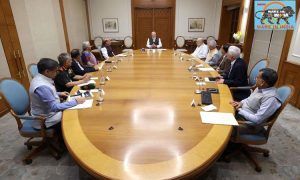
Cabinet approves Upgradation and Modernisation of Nagpur International Airport through long term license involving Private Partner under Public Private Partnership (PPP)
The Union Cabinet chaired by the Prime Minister Shri Narendra Modi has approved the Extension of Lease Period of the Airports Authority of India (AAI)’s land leased to MIL (MIHAN India Limited) beyond 06.08.2039, so as to enable MIL to license Nagpur Airport to the Concessionaire, viz. GMR Nagpur International Airport Limited (GNIAL) for 30 years since Commercial Operation Date (COD).
This marks a major milestone in Nagpur airport’s journey to becoming a regional aviation hub under the Multi-modal International Cargo Hub and Airport at Nagpur (MIHAN) project.
In 2009, a Joint Venture Company (JVC)- MIL was formed by AAI and Maharashtra Airport Development Company Ltd. (MADC) with equity structure of 49:51 respectively. Though Airport assets of AAI were transferred to MIL in 2009 for airport operation, the lease deed got delayed due to land demarcation issues. Subsequently, AAI land has been leased to MIL up to 06.08.2039.
In 2016, MIL floated a global tender for identifying a Partner to operate the airport under the Public-Private Partnership (PPP) model. GMR Airports Ltd. (GAL) emerged as the highest bidder, with quoted revenue share of 5.76%. This was later revised to 14.49% of Gross Revenue. Subsequently, MIL annulled the bidding process in March, 2020. This annulment was successfully challenged by GAL before Hon’ble Bombay High Court. Thereafter, Hon’ble Supreme Court of India also ruled in favor of GAL. Pursuant to Supreme Court Judgement dated 27th September, 2024, MIL signed Concession Agreement with 2nd JVC, i.e. GMR Nagpur International Airport Ltd. (GNIAL) on 8th October, 2024.
A New Era for Nagpur Airport :
With extension of Lease Period of the AAI land leased to MIL beyond 06.08.2039, it would now become co-terminus with the 30 years Concession Period of GNIAL, paving the way for handing over of airport to 2nd JVC-GNIAL. This is expected to usher in a new era of growth and infrastructure advancement for Nagpur Airport. With private sector efficiency and government oversight, the Airport is poised to see significant investment, modernization, and improved passenger and cargo services — Government of India’s vision for robust infrastructure development in the aviation sector.
GNIAL will take up the transformation of Nagpur’s Dr. Babasaheb Ambedkar International Airport into a world-class facility with phased development envisaged to reach the ultimate capacity of handling 30 million passengers annually, positioning it as a key Airport in Central India. This transformation is set to not only enhance connectivity within the Vidarbha region, but also strengthen its economic infrastructure. Cargo handling capabilities would also be significantly boosted.
Cabinet approves Scheme for Promotion of Surface Coal/Lignite Gasification Projects with a financial outlay of Rs.37,500 crore
The Union Cabinet chaired by the Prime Minister Shri Narendra Modi has approved a Scheme for Promotion of Surface Coal/Lignite Gasification Projects with a financial outlay of Rs.37,500 crore.
The Scheme marks a major step towards accelerating India’s coal/lignite gasification programme, advancing the national target of gasifying 100 Million Tonnes (MT) of coal by 2030, strengthening energy security, and reducing dependence on imports of key products such as LNG (more than 50% imported), urea (~20% imported), ammonia (~100% imported), and methanol (~80–90% imported).
In a significant accompanying reform, the Government has also extended coal linkage tenure up to 30 years under the “Production of Syngas leading to Coal Gasification” sub-sector in the Non-Regulated Sector (NRS) linkage auction framework, providing long-term policy certainty for investment in coal gasification projects.
Salient Features of the Scheme:
- Total financial outlay of Rs.37,500 crore to incentivize new surface coal/lignite gasification projects for production of syngas and its downstream products, targeting gasification of approximately 75 Million Tonne of coal/lignite.
- Financial incentive provided at a maximum of 20% of the cost of Plant and Machinery.
- Selection through a transparent and competitive bidding process, with an evaluation framework benchmarking project cost, coal input, and syngas output.
- Incentive disbursed in four equal instalments, linked to project milestones.
- Financial incentive for any single project capped at Rs.5,000 crore; for any single product (except Synthetic Natural Gas and Urea) capped at Rs.9,000 crore; and any single entity group capped at Rs.12,000 crore across all projects.
- Incentive under this Scheme is in addition to, and does not restrict access to, incentives under the commercial coal mining regime or schemes of other Central/State Government ministries.
- The Scheme is technology-agnostic; adoption of indigenous technologies is encouraged.
Strategic and Economic Benefits:
- Expected Investment Mobilisation: Rs.2.5- 3.0 lakh crore
- Energy Security & Import Substitution: Diversified use of coal resources and substitutes imports of LNG, urea, ammonia, ammonium nitrate, methanol, and coking coal, insulating India from global price volatility and geopolitical supply-chain disruptions and advancing the Atmanirbhar Bharat and Make in India objectives.
- Employment Generation: The Scheme is projected to create around 50,000 (Direct + Indirect) jobs across 25 projects in coal-bearing regions.
- Revenue to Governments: Coal/lignite utilization is expected to generate Rs.6,300 crore annually from 75 Million Tonne of gasification envisaged under the Scheme, plus downstream revenue from GST and other levies.
- Technology Ecosystem: Strengthens India’s domestic surface coal gasification capability by advancing indigenous technologies and minimising reliance on foreign EPC contractors.
Background:
India holds one of the world’s largest coal reserves (~401 billion tonnes) and lignite reserves (~47 billion tonnes). Coal accounts for over 55% of the country’s energy mix. Gasification converts coal/lignite into ‘synthesis gas’ (syngas), a versatile feedstock for producing fuels and chemicals domestically, enabling India to substitute high-value imports and insulate itself from global supply disruptions and price volatility.
India’s import bill for key substitutable products LNG, urea, ammonium nitrate, ammonia, coking coal, methanol, DME and others stood at approximately Rs.2.77 lakh crore in FY2025, a vulnerability further exposed by the ongoing geopolitical situation in West Asia.
Building on the National Coal Gasification Mission (2021) and a Rs.8,500 crore scheme approved in January 2024 (under which 8 projects worth Rs.6,233 crore are under implementation), the new Scheme builds on this momentum with significantly enhanced support.
Cabinet approves one new project covering Ahmedabad District in the state of Gujarat, increasing the existing network of Indian Railways by about 134 Kms
The total estimated cost of the project is Rs 20,667 crore (approx.) and will be completed up to 2030-31
The Cabinet Committee on Economic Affairs, chaired by the Prime Minister Shri Narendra Modi, has approved Ahmedabad (Sarkhej) – Dholera Semi High-Speed Double Line project of Ministry of Railways with total cost of Rs. 20,667 crore (approx.). It will be Indian Railways 1st semi high-speed project, planned with indigenously developed technology.
The project section will provide faster connectivity between Ahmedabad, Dholera SIR, upcoming Dholera Airport and Lothal National Maritime Heritage Complex (NHMC). Connecting Ahmedabad with Dholera will cut down passenger travel time enabling comfortable daily commuting and same‑day return trips. This semi high speed railway would not only bring two cities closer but also bring the people living hundreds of kilometers away, closer to each other.
As India’s first semi high-speed rail project, the project will serve as a pioneer project acting as a reference model for the phased expansion of semi high-speed rail across the country.
The new line proposal will provide direct connectivity and improve mobility, providing enhanced efficiency and service reliability for Indian Railways. The project is in line with the Hon’ble Prime Minister Shri Narendra Modiji’s Vision of a New India which will make people of the region “Atmanirbhar” by way of comprehensive development in the area which will enhance their employment/ self-employment opportunities.
The project is planned on PM-Gati Shakti National Master Plan with focus on enhancing multi-modal connectivity & logistic efficiency through integrated planning and stakeholder consultations. These projects will provide seamless connectivity for movement of people, goods, and services.
The project covering Ahmedabad district in Gujarat will increase the existing network of Indian Railways by about 134 Kms.
The proposed projects will enhance connectivity to approx. 284 villages, which are having a population of about 5 lakhs.
The Railways being environment friendly and energy efficient mode of transportation, will help both in achieving climate goals and minimizing logistics cost of the country, reduce oil import (0.48 Crore Litres) and lower CO2 emissions (2 Crore Kg) which is equivalent to plantation of 10 (Ten) Lakh trees.
Cabinet approves Minimum Support Prices (MSP) for Kharif Crops for Marketing Season 2026-27
The Cabinet Committee on Economic Affairs (CCEA) chaired by the Prime Minister Shri Narendra Modi has approved the increase in the Minimum Support Prices (MSP) for 14 Kharif Crops for Marketing Season 2026-27.
Government has increased the MSP of Kharif Crops for Marketing Season 2026-27, to ensure remunerative prices to the growers for their produce. The highest absolute increase in MSP over the previous year has been recommended for Sunflower Seed (₹ 622 per quintal) followed by Cotton (Rs. 557 per quintal), Nigerseed (Rs.515 per quintal) and Sesamum (Rs.500 per quintal).
Minimum Support Prices for all Kharif crops for Marketing Season 2026-27:
(Rs.per quintal)
| S.
No . |
Crops |
MSP 2026-27 |
Cost* KMS 2026-27 |
Margin over cost (%) |
MSP |
MS MSP Increase in 2026-27 | |||
|
Cereals |
2025-
26 |
2013-
14 |
over 2025-26 | over 2013-14 | |||||
| 1. |
Paddy |
Common | 2441 | 1627 | 50 | 2369 | 1310 | 72 | 1131
(86%) |
| Grade A^ | 2461 | – | – | 2389 | 1345 | 72 | 1116
(83%) |
||
| 2. |
Jowar |
Hybrid | 4023 | 2682 | 50 | 3699 | 1500 | 324 | 2523
(168%) |
| Maldandi
^ |
4073 | – | – | 3749 | 1520 | 324 | 2553
(168%) |
||
| 3. | Bajra | 2900 | 1858 | 56 | 2775 | 1250 | 125 | 1650
(132%) |
|
| 4. | Ragi | 5205 | 3470 | 50 | 4886 | 1500 | 319 | 3705
(247%) |
|
| 5. | Maize | 2410 | 1544 | 56 | 2400 | 1310 | 10 | 1100
(84%) |
|
| Pulses | |||||||||
| 6. | Tur /Arhar | 8450 | 5496 | 54 | 8000 | 4300 | 450 | 4150
(97%) |
|
| 7. | Moong | 8780 | 5438 | 61 | 8768 | 4500 | 12 | 4280
(95%) |
|
| 8. | Urad | 8200 | 5418 | 51 | 7800 | 4300 | 400 | 3900
(91%) |
|
| Oilseeds | |||||||||
| 9. | Groundnut | 7517 | 5011 | 50 | 7263 | 4000 | 254 | 3517
(88%) |
|
| 10. | Sunflower Seed | 8343 | 5562 | 50 | 7721 | 3700 | 622 | 4643
(125%) |
|
| 11. | Soybean (Yellow) | 5708 | 3805 | 50 | 5328 | 2560 | 380 | 3148
(123%) |
|
| 12. | Sesamum | 10346 | 6897 | 50 | 9846 | 4500 | 500 | 5846
(130%) |
|
| 13. | Nigerseed | 10052 | 6701 | 50 | 9537 | 3500 | 515 | 6552
(187%) |
|
| Commercial | |||||||||
| 14. |
Cotton |
(Medium Staple) | 8267 | 5511 | 50 | 7710 | 3700 | 557 | 4567
(123%) |
| (Long Staple) ^ | 8667 | – | – | 8110 | 4000 | 557 | 4667
(117%) |
||
*Refers to cost which includes all paid out costs such as those incurred on account of hired human labour, bullock labour/machine labour, rent paid for leased in land, expenses incurred on use of material inputs like seeds, fertilizers, manures, irrigation charges, depreciation on implements and farm buildings, interest on working capital, diesel/electricity for operation of pump sets etc., miscellaneous expenses and imputed value of family labour.
^ Cost data are not separately compiled for Paddy (Grade A), Jowar (Maldandi) and Cotton (Long staple)
The increase in MSP for Kharif Crops for Marketing Season 2026-27 is in line with the Union Budget 2018-19 announcement of fixing the MSP at a level of at least 1.5 times of the All-India weighted average cost of production, The expected margin to farmers over their cost of production are estimated to be highest in case of Moong (61%) followed by Bajra (56%), Maize (56%) and Tur/Arhar (54%). For rest of the crops, margin to farmers over their cost of production is estimated to be at 50%.
In the recent years, Government has been promoting the cultivation of crops, other than cereals such as pulses and oilseeds, and Nutri-cereals/ Shree Anna, by offering a higher MSP for these crops.
During the period 2014-15 to 2025-26, procurement of paddy was 8418 LMT while during the period 2004-05 to 2013-14, procurement of paddy was 4590 LMT.
During the period 2014-15 to 2025-26, procurement of 14 Kharif crops was 8746 LMT while during the period 2004-05 to 2013-14, procurement was 4679 LMT.
During the period 2014-15 to 2025-26, MSP amount paid to Paddy growing famers was Rs. 16.08 Lakh Crores while during the period 2004-05 to 2013-14, amount paid to farmers was Rs. 4.44 Lakh Crore.
During the period 2014-15 to 2025-26, the MSP amount paid to 14 Kharif crops growing famers was Rs. 18.99 Lakh Crores while during the period 2004-05 to 2013-14, MSP amount paid to farmers was Rs. 4.75 Lakh Crore.