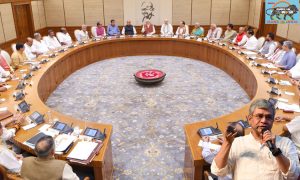
The Union Cabinet chaired by the Prime Minister Shri Narendra Modi today has approved declaration of Madurai Airport, Tamil Nadu, as an International Airport.
Madurai Airport, located in the Temple City of Madurai, Tamil Nadu, is one of the oldest airports in the State. It serves as a crucial gateway to Southern Tamil Nadu and plays a pivotal role in promoting tourism and pilgrimage, thereby contributing to the overall growth of the region.
Elevating Madurai Airport to International Status would enhance regional connectivity, promote trade, and drive economic development in the region. The airport’s potential to attract international pilgrims and businesses aligns with the city’s historical prominence.
The Union Cabinet chaired by the Prime Minister Shri Narendra Modi today has approved Ministry of Jal Shakti’s proposal to restructure and reorient the implementation of the Jal Jeevan Mission (JJM) from infrastructure creation to a service delivery, supported by drinking water governance and institutional ecosystem for sustainable rural piped potable water supply.
For restructuring JJM focussing on structural reforms, Cabinet has approved enhancement of total outlay to Rs. 8.69 lakh crore with total central assistance of Rs. 3.59 lakh crore enhancing from Rs. 2.08 lakh crore approved in 2019-20 i.e. additional central share of Rs. 1.51 lakh crore.
To this end, a uniform national digital framework, namely “Sujalam Bharat”, shall be instituted, under which every village shall be assigned a unique Sujal Gaon / Service Area ID, digitally mapping the complete drinking water supply system from source to tap. For ensuring transparency and accountability the involvement of GPs and VWSCs in the commissioning and formal handover of schemes through “Jal Arpan”.
A Gram Panchayat shall certify completion of works and declare itself “Har Ghar Jal” only upon confirmation that adequate in-village operation and maintenance mechanisms have been established by the State Government. Recognizing that community ownership and participation are critical for operational efficiency and source sustainability, the programme shall promote “Jal Utsav” as an annual, community-led maintenance and review event, integrating local cultural ethos while reinforcing collective responsibility for drinking water secure future.
From the baseline of 3.23 crore (17%) rural households with tap water connections in 2019, so far, more than 12.56 crore additional rural households have been provided with tap water connections under JJM. At present, out of 19.36 crore rural households identified by the States/UTs in the country, around 15.80 crore (81.61%) households are reported to have tap water connections as on date.
Beyond the physical achievements, impacts of JJM have been assessed by reputed national and international institutions/ individuals. SBI Research reported that JJM has freed 9 crore women from fetching water, enabling greater participation in other economic activities. World Health Organisation (WHO) estimated reduction in women drudgery by saving of 5.5 crore hours daily, prevention of 400,000 diarrheal deaths, and savings of 14 million Disability Adjusted Life Years (DALYs). Nobel laureate Prof. Michael Kremer estimated a potential of 30% reduction in under-five mortality, saving 1,36,000 lives annually; IIM Bangalore & International Labour Organisation (ILO) estimated generation of 59.9 lakh direct and 2.2 crore indirect person-years of potential employment, strengthening rural livelihoods through JJM. Women and the girl child have emerged as the principal beneficiaries of this intervention, with substantial gains in terms of reduced drudgery, improved health and hygiene, enhanced dignity, and greater opportunities for education and livelihood activities.
JJM 2.0 would facilitate the certification of all Gram Panchayats as ‘Har Ghar Jal’, by provisioning tap water connection to all the 19.36 Crore rural households across the country by December 2028 while ensuring adherence to timelines, scheme sustainability, and delivery of citizen-centric water services through Separate MoUs with State/UTs. JJM 2.0 also fosters the vision of Viksit Bharat @2047 with assured 24×7 rural drinking water supply by shifting from infrastructure-centric approach to a citizen-centric utility-based service delivery approach through Structural Reforms.
With Whole of Government approach, Strategic convergence among various Departments at Government of India level for sustainable and long-term operation and maintenance of rural water supply infrastructure and scheme source sustenance has also been envisaged under Jal Jeevan Mission 2.0.
The Cabinet Committee on Economic Affairs, chaired by the Prime Minister Shri Narendra Modi, today has approved the Revised Total Capital Cost of Rs.3630.77 crore for the Construction of Greenfield Connectivity to Jewar International Airport from Delhi-Faridabad-Ballabhgarh-Sohna Spur of the Delhi-Mumbai Expressway on Hybrid Annuity Mode in the States of Uttar Pradesh and Haryana.
This 31.42 km long project corridor will provide direct and high-speed connectivity from South Delhi, Faridabad and Gurugram to Jewar International Airport, thereby promoting economic growth and logistics efficiency across National Capital Region (NCR).
The corridor intersects Eastern Peripheral Expressway, Yamuna Expressway, and Dedicated Freight Corridor (DFC), enabling multimodal transport convergence. The elevated corridor is not merely a structural enhancement but a strategic enabler for urban transformation, regional connectivity, and national logistics efficiency. Its construction is imperative to unlock the full potential of the Jewar Airport–Delhi–Mumbai Expressway corridor and to ensure sustainable urban development in Faridabad.
About 11 km length of this project is to be developed as elevated highway which forms a critical segment of the Greenfield connectivity between DND-Ballabhgarh Bypass and Jewar International Airport, linking it to the Delhi-Mumbai Expressway. This corridor traverses the area earmarked for high-density urban development and future infrastructure expansion under the Faridabad Master Plan, 2031. The additional cost of the proposed elevated corridor is Rs.689.24 crore and the Government of Haryana has agreed to bear Rs.450 crore for elevated corridor.
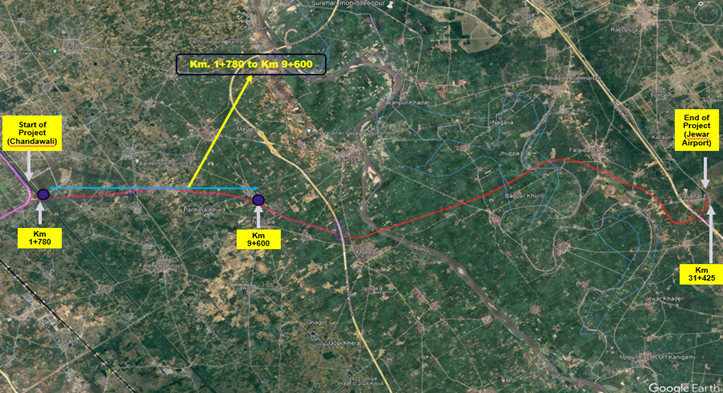
Project Alignment Map for Greenfield Connectivity to Jewar International Airport from Delhi-Faridabad-Ballabhgarh-Sohna Spur of the Delhi-Mumbai
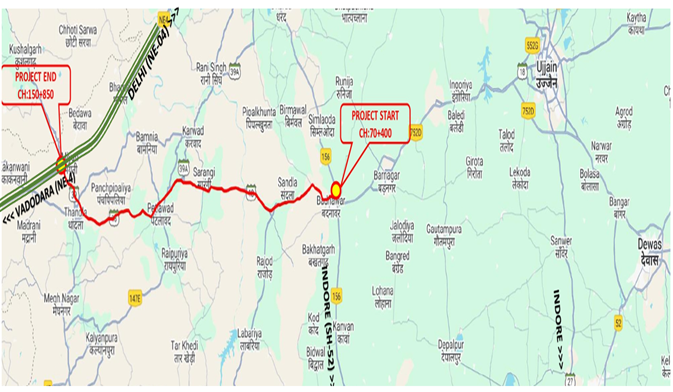
The Cabinet Committee on Economic Affairs, chaired by the Prime Minister Shri Narendra Modi, today has approved the development of a 4-lane corridor from Badnawar-Petlawad-Thandla-Timarwani section of NH-752D having a length of 80.45 kilometer with a total capital cost of Rs.3,839.42 crore.
The approved corridor will provide connectivity of Ujjain to Timrawani interchange at Delhi Mumbai Expressway (DME).
The primary purpose of the proposed four-lane project corridor is to improve travel efficiency and is expected to reduce travel time by approx. one hour. The Ujjain–Badnawar section of 70.40 km Length has been already upgraded from 2-lane to 4-lane. The instant Badnawar–Timrawani stretch is an exisiting intermediate lane (5.5m) with poor geometry (Speed 20-50 kmph). Upgrading this section will complete the direct 4-lane connectivity from Ujjain to Timrawani interchange at Delhi Mumbai expressway (DME) with Speed 80-100 kmph.
The Timarwani–Thandla–Petlawad–Badnawar–Ujjain corridor is the shortest route for traffic from Gujarat and Maharashtra to Ujjain. Upgradation of the Timarwani–Badnawar section will strengthen inter-state connectivity and enable efficient movement of traffic and would also take care of surge in traffic during Simhastha Kumbh Mela in April-2028.
Badnawar-Petlawad Thandla-Timarwani Section traverses through tribal regions of Dhar & Jhabua Districts. Parts of Dhar District are covered under the Aspirational Blocks Programme of NITI Aayog. The up-gradation of section will provide direct and faster access from the Ujjian-Badnawar–Timarwani corridor to the Delhi–Mumbai Expressway. This improved linkage will reduce lower logistics costs, facilitate efficient movement of raw materials & finished goods and strengthen access to industrial hubs/MMLPs, situated at Indore, Pithampur,Ujjain and Dewas.
The proposed project provides high speed connectivity designed for improved safety and uninterrupted traffic movement, reducing travel time, congestion, and operating costs. Importantly, the project will enhance the basic infrastructure in the region, contributing to the overall economic development of Dhar and Jhabua districts in the state of Madhya Pradesh.
The salient features of the project are as under:
| Sr. No. | Project Features | Details |
| 1 | Length | 80.45 kms (Greenfield + Brownfield) Corridor |
| 2 | Type of pavement | Flexible Pavement |
| 3 | Proposed Configuration | 4-Lane |
| 4 | Major Bridges | 06 |
| 5 | Minor Bridges | 34 Nos. |
| 6 | RUB (Road Under Bridge) | 01 Nos. |
| 7 | VUP / LVUP/SVUP | 9 Nos. / 29 Nos. / 04 Nos. |
| 8 | Construction period | 24 months |
| 9 | Concession Period | 17 Years (2 Yrs Construction period + 15 Yrs O&M) |
Annexure-I
Cabinet approves two multitracking projects covering 5 Districts of West Bengal and Jharkhand, increasing the existing network of Indian Railways by about 192 Kms
The total estimated cost of the projects is Rs 4,474 crore and will be completed up to 2030-31
The Cabinet Committee on Economic Affairs, chaired by the Prime Minister Shri Narendra Modi, today has approved 02 (Two) projects of Ministry of Railways with total cost of Rs. 4,474 crore (approx.). These projects include:
- Sainthia – Pakur 4th line
- Santragachi – Kharagpur 4th line
The increased line capacity will significantly enhance mobility, resulting in improved operational efficiency and service reliability for Indian Railways. These multi-tracking proposals are poised to streamline operations and alleviate congestion. The projects are in line with the Prime Minister Shri Narendra Modiji’s Vision of a New India which will make people of the region “Atmanirbhar” by way of comprehensive development in the area which will enhance their employment/ self-employment opportunities.
The projects are planned on PM-Gati Shakti National Master Plan with focus on enhancing multi-modal connectivity & logistic efficiency through integrated planning and stakeholder consultations. These projects will provide seamless connectivity for movement of people, goods, and services.
The 02 (Two) projects covering 05 Districts across the states of West Bengal and Jharkhand will increase the existing network of Indian Railways by about 192 Kms.
The approved multi-tracking project will enhance connectivity to approx. 5,652 villages, which are having a population of about 147 lakhs.
The proposed capacity enhancement will improve rail connectivity to several prominent tourist destinations across the country, including Bolpur-Shantiniketan, Nandikeshwari Temple (Shaktipeeth), Tarapith (Shaktipeeth), Patachitra Gram, Dhadika Forest, Bhimbandh Wildlife Sanctuary, Rameshwar Kund, etc.
The approved projects are essential routes for transportation of commodities such as coal, stone, dolomite, cement, slag, gypsum, iron and steel, foodgrains, POL, container, etc. The capacity augmentation works will result in additional freight traffic of magnitude 31 MTPA (Million Tonnes Per Annum). The Railways being environment friendly and energy efficient mode of transportation, will help both in achieving climate goals and minimizing logistics cost of the country, reduce oil import (06 Crore Litres) and lower CO2 emissions (28 Crore Kg) which is equivalent to plantation of 01 (One) Crore trees.